SCENE: Our hotel room in Salvador, Bahia; October 5th: A news item on TV mentions a Nigerian fishing boat that has washed up on a beach in the state of Rio Grande do Norte (our state) after 35 days at sea, both engine and generator having failed.
SCENE: Back home; October 7th: Our caretaker, Marcos, tells us that the Nigerian Fishing boat is stranded on Buzios Beach, two beaches south of us.
SCENE: Buzios Beac h, October 10th: We have driven 20 minutes south to check out this stranded fishing boat. It is pretty big and very rusty. Only onlookers are there. We stop by Pirangi Beach to see our American friend, Mary, on the way home. She tells us about her Brazilian friend Glades becoming the official helper of the African fishermen, being the first person to meet them who spoke English.
SCENE: Home office, reading this e-mail from American friend, Mary; October 12th. :
“A wonderful adventure this morning that merits recording ... an African trawler ran aground in Buzios last week, the beach just south of ours, and it quickly became a tourist attraction. I haven't gone to see it, but Glades, who just told off her boss at the travel agency and thus has some free time now, wandered up there one day and began to befriend the six stranded English-speaking Nigerians (well, one is from Benin and two are from Ghana, all employed by a Nigerian fishing company). First she translated a local newspaper article about their plight for them, and, before she knew it, she was their official interpreter regarding matters of their status and finances – in meetings with the Navy, with the bank, with the local community. She’s their hero! They call her “Mama.”
The guys are mostly in their thirties, some with wives and kids at home, whose fishing boat in Nigerian waters simply lost all power one day, and they drifted for over a month with plenty of fish to eat but scarcely any water. They arrived in various degrees of dehydration and depletion, one injured and near death. The Tabatinga Beach community housed them at first - the caretaker of one house opened it up when he saw their desperate state, till the absentee landlord found out and unkindly objected. Another resident offered his mother's vacation house, but this happens to be a holiday weekend, and she was using it.
So where did they end up temporarily ... at Glades' of course, in the bunk beds and extra rooms of her apartment!
So that's why we invited them for breakfast this morning...we quickly threw together a hefty brunch. The local market donated a bag of apples when I said we were feeding the Nigerians, who are famous now up and down the beach. Jose made something spicy with manioc and coconut milk and veggies that they all loved and said reminded them of their traditional food. One couldn’t come - a combination of wooziness and homesickness I think, and when I packed some leftovers for him later, one of the guys asked if he could take half an apple to his friend. I gave him the whole donated bag, but was struck by the humility of his request.
One guy, the captain, talked the most and was obviously the most comfortable among strangers. The others were mostly reticent, shy, but quick to smile. One limped, and when asked why, said he was shot by pirates last year. Apparently Nigeria has the greatest incidence in the world of that particular danger. Being Sunday, no employees were here today, but three of them quickly came when called and gave the fishermen a capoeira demo and lesson, and the Nigerians said they were able to laugh today for the first time.
Even though the banks are on strike in Natal right now, the group managed to retrieve some funds their company sent to tide them over (the striking bank opened its doors after being commanded to do so by higher authorities, at Glades' insistence). Whether the boat gets repaired enough for them to navigate it home, or whether the company will decide to sell it or abandon it and fly them home is still undecided (no doubt they're hoping for the latter). The highest tide of the year is conveniently one week away, and at that time they will attempt to tow the boat up to the Natal port. 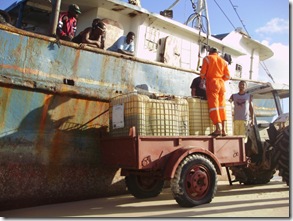 Meanwhile, IBAMA (equivalent of the EPA) ordered that the hull's oil and dirty waters be drained, to avoid an ecological disaster. But the presence of such a novelty on the beach is a huge magnet - to invasive tourists who climb aboard uninvited and to thieves, who walked off with everything of value that was left unguarded in the first days of their recovery. The clothes on their backs are all donations at this point.” [In the photo above l to r: Williams, Mary, Charlie, Leandre, Glades,Captain, Francisco]
SCENE: Our bedroom on a sunny morning, my mind in a half-sleep trying to decide how to help the African fishermen; October 15th: I come up with the idea of offering them use of our Skype computer phone, which is extremely cheap for international calls. Though they may mostly need money from us, salary cuts and the falling dollar have carved out a big percentage of our income. I later get Glades’ number from Mary and call.
SCENE: Home office and front porch; October 19th: Glades brings the Nigerian, Williams (his first name), the assistant engineer of the boat, who reaches his brother to explain his long absence, then reaches the boss of the fishing company. An e-mail with a photo of the beached boat is sent to the boss. Williams is the one who limps from the pirate gunshot in the leg, but he manages a swagger simultaneously! He has a gregarious and confident personality, is single, has become Glades’ boyfriend, and wishes to st ay in Brazil. But he is very proud of the prosperity Nigeria is currently enjoying through its resources and industries. I put some African music on the iPod and he teaches me the ‘high life’ style of dance that is popular in Western Africa. I love the economy of his moves, just like the Cubans in the “Buena Vista Social Club.”
Glades has had to sign something saying she is responsible for the fishermen, so the Brazilian government at its various levels is proving to be very slow and minimal help. Apparently a lawyer has advised them not to talk to the sometimes-harassing media after misrepresentations occurred. She has negotiated a good deal on a rental beach house for them near their boat. It is necessary for them to guard the boat around the clock from thieves who they believe could take the broken motor (about all that’s left to take, now that the compass, GPS, clothes, pots and pans, DVD player, etc. are gone). Glades says that while the six of them were staying at her apartment, they kept the place spotless and neat, cooking most meals themselves. Williams is still staying at Glades’.
SCENE: Home office and front porch; October 21st: Glades and Williams bring Nigerians Captain Franklin da Silva (l) - ironically, he has one of the most common names in Brazil…due to Portuguese colonies in 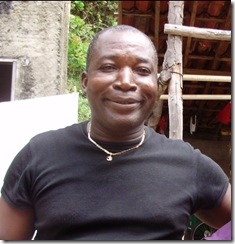 Africa, though he doesn’t speak any Portuguese; and Indian Gandhi (r) -the son of a tribal chief with three wives, who is the boat’s engineer. ‘Capi,’ as they call the captain, has not been able to reach his wife because her cell number changed. He reaches her brother and for the first time is able to leave the cell phone number where he can be reached in Brazil. His face reflects an incredible amount of relief and joy now that his loved ones know he is not dead and his wife will be calling soon. He has two older sons who study banking in Ghana and a small boy and baby girl by his second wife.
Indian suffered some horrible impact with something in the water when the fishermen left the boat to swim ashore. It was night and they feared the boat would capsize or crash into rocks, so they swam. Buzios has the strongest current of all the beaches in this area, so the dehydrated and depleted guys had a very difficult swim to shore. Indian had to be placed in a rubber life boat after Williams noticed him facing downwards in the water. He has spit up blood for which the local free hospital treated him and gave him some medicine that greatly helped. They all grabbed their passports from the boat, but unfortunately all but one was lost on the swim to shore. Besides suffering physically, Indian – who has a wife (“just one wife in my generation”) and four daughters - has also not reached anyone to tell them of his fate. He is particularly forlorn and homesick, knowing his family has no income. He reaches his wife’s brother and reports his surprising whereabouts and phone number; his face is then also transformed by happiness! The fishermen were not actually sure where they were when they landed, which seems strange since the sun must have clearly indicated their direction. Their battery-run compass and GPS had also stopped working. I think they may have been confused about geography because of their depleted state, thinking that the Portuguese being spoken might have been from another African country. I see that they are not ignorant people. They described huge storms at sea, where they would rise to the top of a gigantic wave and then hold on tight for the drop, or where water would powerfully wash over the deck, also requiring them to hold on for dear life. The boat is large enough that it did not threaten to tip over. They saw a pair of whales - bigger than their boat – who swam around and under them but did not present a danger.
Captain says that all the beach cafés in Buzios close at 6:00pm when it gets dark, so the fishermen are just stuck in their house all evening with no place to go. I send some playing cards home with them.
SCENE: Home office; October 27th: Williams shouts at the fishing company boss over the Skype phone for not sending any further financial help; Glades has been unemployed since right before meeting them, so there are money worries all around. Williams is trying to coordinate with the fishing company boss to pay someone to tow the boat out to sea and up to the port for sale or repair, as that highest tide proved not to budge the boat one inch.
We send a twelve-pack of beer and a stack of DVD’s home for the group.
SCENE: Zen Bar Café, Cotovelo; November 5th: We’ve invited the fishermen for an evening out at our favorite local bar, run by our friends Maurizio (Italian) and Neuma (native), who have a wealth of world music and a sylvan setting in their courtyard. We have requested African music. Only Glades, Williams and Indian show up. We’re beginning to suspect that our offerings via Glades and Williams are not making it to the group at large, among whom there is some tension about the company dealing with Williams, who is more aggressive, maybe cleverer, and more vocal - instead of Captain, plus the usual strains of people who have been through such stress. Indian was coughing up blood again and worried sick about his family back home, so he is staying with Glades also.
After some great tunes which Williams and Indian identify as from their neighboring country, Cameroon, they ask Maurizio if he has any Fela Kuti music. Of course he does and they light up to hear their favorite Nigerian, political activist/icon’s wonderful “African Beat” synthesis of jazz, protest song and traditional African rhythms. The two of them tell us all about the political turmoil, the complete adoration of the populace, and the eccentricities that defined Fela Kuti’s outsized life .
.
SCENE: Pirangi bus stop; November 6th: I run into Glades, Williams and Indian waiting for a bus to Buzios. I give them a lift to the rental beach house and finally meet the other three fishermen: Leandre from Benin, (r) amazingly pitch-black and gracious - a former farmer and French teacher with two sets of boy/girl twins, ages 10 and 7; Charlie (l),Ghanan, a charming, funny, ladies’ man with a boy, 10, and a girl, 8; and Francisco (r, below), Ghanan, painfully shy, separated with a 5-year-old boy. He speaks the least conventional English and has more trouble understanding everything. I am enchanted to see how clearly the six demeanors reveal such distinct personalities…and all just lovely guys.
They’ve managed to lug the bo at’s broken generator all the way to their living room. They want to repair it and sell it since they are getting nothing from their company.
The Natal police chief has become the most helpful, and efforts have been successful to replace the lost passports with temporary ones from their respective governments in Africa, excepting Francisco who is still waiting. Charlie is the one whose passport made it to shore, and there was talk of sending him home early to try to coordinate efforts with the company to salvage the boat, but Glades thinks the police want to wait till all of them can fly back together to save money by sending only one police escort to São Paulo (from where the flight to South Africa and then their respective countries would origina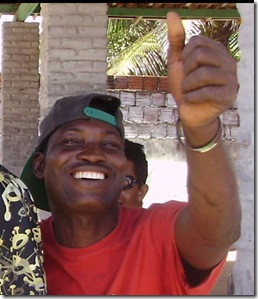 te). This escort is
necessary because of their unusual/illegal status.
I now have the opportunity to invite all of the fishermen directly for the week-after-next to a simple bar in our local town which serves acarajé, an African-Brazilian dish from Bahia.
SCENE: Home office; November 8th: I ask Newton how the name of that famous Nigerian musician we heard at Zen Bar is spelled. He says “F-E-L-A K-U-T-I.”
About two hours later I see on the front page of the online NY Times a photo of African dancers with a caption of “Fela!” below it. Sure enough, a Broadway show about Fela Kuti just opened! The article is fascinating, both because the details of Fela Kuti’s life are so dramatic and because the creators of the show refused to let the usual Broadway producers touch it and commercialize it. Fela Kuti, from Lagos, Nigeria’s largest city, was educated in the UK and the US. He returned to Nigeria in the ‘70’s with the jazz rhythms he picked up, but preferred to contest the corrupt military government and the effects of colonialism by singing in the patois language of the people. (The show features supertitles over the stage like they use at the opera to translate into English.) His Mother was a feminist who the authorities threw from a window to her death; Fela had 27 wives (not feminists) who sang and danced in his shows in a large club in Lagos. They lived in a huge complex which the authorities eventually burned to the ground. Fela was jailed and beaten many times, but always came back with his signature humongous joint of marijuana and his music of protest against each subsequent version of corrupt government. The fishermen think his death “from AIDS” in the mid-‘90’s was actually caused surreptitiously by the authorities.
The creator, director and choreographer for the show is the renowned modern dance choreographer, Bill T. Jones. The producers he gathered from the art world are dedicated to an authentic depiction of Fela Kuti’s music and his life story without the usual compromises to make the show ‘marketable.’ Apparently the result is fresh, dramatic, and thrilling.
SCENE: Sampa’s Bar, Pium; later: At last we can give all the fishermen a night out! They all show up for the spicy acarajé in Pium. Mary also joins us. Williams leads a prayer before we eat, as they are all Christian and have taken to praying together throughout their ordeal. When the subject of thieves comes up, since in general what they like best about Brazil is the people they have met - they mention that thievery is also prevalent in Nigeria, even the theft of items – including Bibles – at church! A discussion ensues about when God forgives the theft of a Bible and when he does not.
The fishermen find the ‘extra pimentada’ acarajé mild by their standards. The bar plays some nice recorded samba instead of the usual forró we’re not too fond of around here, so I make the Africans try out the dance of Brazil. Glades and Mary help me pull them to their samba fate!
I love telling them the Fela Kuti coincidence about the Broadway show, and that in the meantime I’ve been able to nab some surprisingly affordable tickets to the show in late January when I’ll be in NY.
Nothing seems to be moving along with the resolution of the stranded boat and the fishermen’s passage home. The initiative to tow the boat seems to have evaporated, along with any more contact from their boss. There is a possibility that some guy could come repair the boat right on the beach. Newton and I really don’t know where they’re getting any money to live on, even though Glades may have resources from her family in Rio Grande do Sul. The guys have become friends with several people near their house and have a support system of sorts, fraught with sign-language! Captain handed over money so Newton could add credit via the internet to his cell phone SIM, by which they all communicate with their families now.
Charlie tells me that he would like to return to Brazil to study at a maritime college. He asks if I could get any information from the internet about such colleges in Brazil.
SCENE: Buzios Beach, next to the boat; some days later: Newton had arranged to meet the guys by the boat where they play a lot of soccer. Even though they are tired from the pick-up game they played for hours the day before with a revolving cast of players that showed up, Captain, Indian, Francisco and Charlie come over from the house, bearing cans of cold beer they take great pleasure in presenting to us. I am relaxing in the shade of the boat. Leandre, the most devout, is at church in nearby Tabatinga, even though it is Catholic and in Portuguese.
We learn that if the Brazilian government pays for their plane tickets back to Africa, the fishermen will be considered deported and unable to return to Brazil. They can reimburse the government at a later date and return to Brazil (since they are not allowed to work here now). Now Francisco wants to stay in Brazil, too! The siren song has worked some magic on them, even though Captain, Indian and Leandre really want to get home to their families. Charlie is ecstatic to get the information I printed out from the internet about the two branches of the maritime college in Brazil (in Rio and Belem), complete with courses and application. There is a program for foreigners with free room and board. Charlie says there is someone in Dubai who would sponsor his tuition.
As usual, many curious people come by to see the boat and what the buzz about the Nigerian fishermen is all about. Many take photos. Most do not speak English.
We invite the fishermen to come to our house soon for our very spicy chicken wings and Fela Kuti music.
SCENE: The ‘artesano’ market for tourist souvenirs in Natal; some days later: I have decided that what is needed is some gifts for the fishermen to give their wives and children when they return to Africa. I’m thinking they might even make it home by Christmas. My budget is limited, but I have some great paper dolls and scissors I brought from the US, including Obama family paper dolls. The fishermen assure me that everybody in Africa, including children, knows who Obama is! Then I have some Brazilian beads and African beads I have strung into necklaces for the wives/girlfriends. Now I need to find the cheap version of the official soccer shirts of the Brazilian national team for boys 23, 19, 10 (two), 8, and 7. It takes a grueling long while after grueling negotiations, but the store finally finds all the right sizes, thanks to their second store to which they run off a couple of times. This project puts me decidedly in the Christmas spirit.
SCENE: Our front porch; December 10th: The coconut trees in the front yard are wound with red and green tube lights, respectively. The Africans and Glades are approaching down the road from the bus stop. Newton hands me the iPod newly loaded with Fela Kuti music and I push the buttons just in time for the music to start as they approach the gate.  The next hour-and-a-half is spent with all nine of us dancing on the front porch, loads of smiles, juice/beers-in-hand, and plenty of singing along to all the Fela Kuti lyrics (often explained/translated for us). The guys are transformed into now graceful, now funny, butt-bumping, now floating, now earthbound moving mantras, all of which I’m trying to mimic. Francisco makes dancing look like rhythmic Tai-chi …utterly graceful and evocative of animals and birds. I think I'm adding him to my Fred Astaire/Baryshnikov list! When dancing, Francisco is not shy; Captain’s swollen, dislocated knee does not impede motion; Williams does not limp; Indian’s joyful animation is not limited by his lung injury; and the staid, teetotaler Leandre occasionally gets up from his chair and carefully steps to the beat. No matter how relaxed I try to be copying their moves, I can always see how much more effort I am making, how much more my arms move. Captain says ‘release’…and there’s a look at a western life. That economy and release are the story of a psychological and spiritual freedom.
At last we collapse onto sofa and chairs. Time to put out the chicken wings, rice and beans, and malageta hot peppers. We have a wonderful time eating and gabbing. I hand out the bags with presents for them to take back. Williams leads them in a sung blessing for us – this is so beautiful, I almost die. Their voices answer Williams’ gorgeous sung phrases in chant-like, melodic responses. It sounds more beautiful than Ladysmith Black Mambazo. I may not be religious, but I definitely know when a sublime blessing is engulfing me.
SCENE: Buzios Beach; December 13th: We arrive at 10:30am for a proposed soccer game, but the tide is higher than calculated, so the guys, other than Francisco waiting for us, are at the house. Francisco is no longer shy with us, and we run down the hill of sand hand-in-hand to the boat for photos. Alas, our camera is kaput. Cell phone camera.  Their artist friend nearby has painted “Please do not enter” on the side of the boat. We go to the house with a cooler of beer. Captain is in the kitchen working on the African lunch we’re sharing with them. Williams wants a ride to a lake in Tabatinga, so we drive him over and meet Eugenio, the Brazilian man who was the first to help them when they arrived desperate on the beach. He owns a little bar at the lake. Williams buys some beers for us. Leandre is in the yard beside the bar shelling shrimp for Eugenio after church. Williams has just heard from the long-lost boss in Nigeria, who must have realized how expensive it would be to replace that boat. Maybe now he’ll enable them financially to get it repaired to return home or sell. We return to the house for Captain’s lunch. First, a shot of scotch to open the gullet. There are pieces of chicken –separate - and a mash of beans, manioc and coconut meat to which one adds the blend of
  tomatoes, peppers and onions sautéed in dendé (coconut oil). This is eaten with the hand, first worked all together into a ball, then held and nibbled from red-stained fingers. A bowl of water sits near-by for finger-dipping. IT IS DELICIOUS. The beer comes after and manages to inflate the bulk of deliciousness in the stomach. Very satisfying.
I comment about their perfect teeth…they all have beautiful teeth. Then they show me the ‘chewing stick’ that is commonly used in Western Africa, following the toothbrush. I believe it may be a root. This item was not stolen from the ship! One chews on the stick as a sort of flossing, except it appears to be more effective. They also said that people do not consume much sugar there. I suggest a chewing stick export business when they return!
Captain has an invitation from a woman he met who owns a bar/restaurant at the other end of Buzios Beach. Most of us pile into the car and go. We all sit under a thatch umbrella by the water and Andrea serves us beer after beer and shrimp and fish, which Williams, Captain and Indian share. We’re too full. After a relaxing afternoon conversing about Nigeria, theology and pigeon English, we all say farewell. Newton and I are off to the USA for Christmas, returning January 4th. None of us knows if the fishermen will still be here then.
I questioned my wish to know and help the Africans when there are people all around us every day who I do not help. The fishermen’s plight seemed particularly strange and desperate – whereas the poor near us are neither homeless nor abandoned and speak the same language as everyone else. Perhaps I was drawn to the local celebrity of the Africans? Or that they would be leaving and not a permanent fixture like the local poor who would never stop appearing with a hand extended if we were to succumb. Finally, I decided that if someone needs help and I wish to provide it, it is not so complicated. Getting to know them and offering what we could has been a supreme pleasure, mostly because of the sheer loveliness of each of the men and their example of dignity and ‘release.’ There is so much for us all to learn. It feels like love, but an uncomplicated version, where we offer our best mutually.
Wishing all of you a spark of connection during this holiday season!
Love,
Sandy


