Newton had a professional trade show in Brasília over a long weekend. I had never been there, so off we flew.
Brazil had a president from 1956 to 1961, Juscelino Kubitschek, known as “JK,” who believed that the southern states of Brazil were benefitting disproportionately from the seat of the federal government being located in Rio de Janeiro. He was determined to build a new capital in the middle of the country and spread economic development more equitably into the northern states.


The chosen site for the Federal District was in the state of Goiás. It was a dessert, a rough savannah. Lúcio Costa won a contest to design the city plan, and famous Brazilian architect, Oscar Niemeyer, designed the government buildings and monuments. Lúcio Costa’s layout was based on a bird with outspread wings, with specific sectors for specific purposes. The government buildings are along the ‘axis’ of the bird, as are the hotel sectors and public spaces. The wings are residential. Kubitschek knew that with some strong opposition to his plan he had to move swiftly and complete the city before his term ran out; otherwise, the project could potentially end up abandoned by a subsequent administration. Sixty thousand workers worked day and night to complete the project in less than four years.
 Kubitschek was the third generation of an immigrant family from Czechoslovakia. His presidential term was considered a prosperous time of optimism and economic expansion in the country.
After Kubitschek’s single five-year term, as was the law at that time, he returned to being a senator. In 1964, the USA clandestinely participated in the military coup that took over Brazil to both fight “Communism” and install a regime offering Brazil up to American corporations. When congress was dissolved, Kubitschek went into self-exile in Europe and the US. He returned to Brazil and died in a car accident in 1976. Some consider his death and that of his democratic successor suspicious, as the USA-aided Operation Condor carried out numerous assassinations in Brazil, Argentina, Chile, Uruguay, Paraguay and Bolivia (later Peru and Ecuador) to minimize opposition to the right-wing dictatorships. This is why South Americans think more highly of American citizens than they do of the American government, complicit in those decades of repression, torture, and disappearances.

As Newton and I drove from the airport, we saw a sixties’ style city that seemed somewhat crumbling. There was graffiti everywhere and buildings in disrepair. We swerved into town on the quite interesting thoroughfares that have no traffic signals – just exit ramps and cloverleaf’s. Fortunately, we finally got our GPS to register the truly strange address system and found our way to our hotel at SHS QD 05 BLC! (Hotel Sector South, quadrant D, #5, block C). Our friend told us that after a week’s use this address system is truly efficient, but I have to admit to some nascent affection for the GPS as our few days in Brasília were not sufficient to assuage our utter address confusion. You can see here that this is the dry season – four months without rain and everything brown. We even saw a section of a park being blackened by spontaneous fire.
While Newton worked, I took a marvelous tour of the city with some Brazilians, Germans, an Argentine and a Uruguayan. We had a lot of fun sharing impressions and comments. The axis area of the city’s lay-out is much more attractive and maintained.
Many of Niemeyer’s buildings here, while elegant, seem to say “the sixties” more than evoking lasting grandeur. They better serve to represent a moment in modernism, as does Lincoln Center in New York in my opinion. Here are the Palácio do Planalto (like the White House, except the president’s residence on the right is located elsewhere) and the Supremo Tribunal Federal (the supreme court) in the ‘Plaza of the Three Powers:’

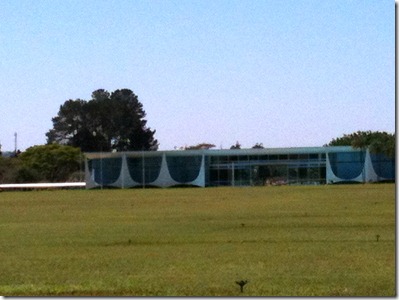

But the plaza’s third building transcends sixties’ architecture and becomes sculptural art: the Congresso Nacional, which is timeless in its beauty and thrilling to see from any angle:


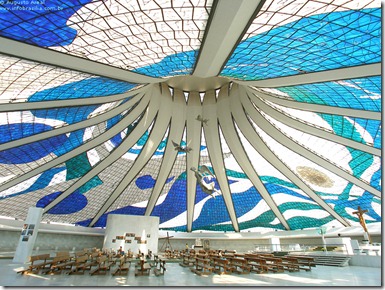
 Here is Oscar Niemeyer’s Catedral Metropolitano, modeled on the crown of thorns. I am not fond of the architecture, though the engineering feat is very impressive. My favorite detail in Brasília is front and center in this cathedral: an egg. With a yoke. Clearly, this is the pre-Christian symbol of birth, co-opted as Easter eggs, but I have seen few featured as this one is in church design. But better still, these stained glass ‘waves’ of clouds and sea culminate in the blue fallopian tubes and green uterus under the egg. Oscar Niemeyer worked female anatomy into the central symbol of a Catholic church! I checked with the tour guide about Niemeyer’s religious affiliation, which is atheist/communist (he was forced into exile under the military dictatorship, returning only when democracy was restored in the mid-eighties). I considered the egg detail at least a wink from Oscar, who is still with us at age 105.

Newton and I went out on our first night to Beirute, a place Wikipedia describes as the spot for local intellectuals, journalists, gays, and students. It definitely looked like nothing had physically changed since its opening in ’66, but the crowd was a refreshing mix of generations, and short on tourists. The Arabic food was so-so, the draught beer very cold.
A gigantic manmade lake surrounds this bird-in-flight layout to the southeast. It was created to supply much needed humidity to the city. Newton and I went to Pontão, a beautiful area on the lake full of bars and restaurants. While exploring we came upon some live jazz and were hooked (being jazz-starved in Natal). We returned the following night for a different piano trio, equally adept as the first. Sheer heaven.
 We struck out on a walk one morning, literally and figuratively, despite having read that this is no city for pedestrians. The “central park” of Brasília is just around the corner from our hotel. Whether the difficulty of crossing that flowing traffic without any crosswalks or the scorched brown color of the park under a sweltering sun was the determining factor, we decided to return to the hotel and drive 50 kilometers to an ecotourism spot with waterfalls. We didn’t anticipate that the route had its percentage of dirt roads. Even with the car closed up with A/C we could taste the dry red dirt in our mouths. If a car passed us, our visibility was completely obliterated. Alas, when we arrived at our destination the guided tours to the waterfalls were over. We were just grateful for shade, food and liquid at that point. Thank goodness the camp-like place was serving a great home cooked meal to the day’s hikers. Our senses were well served by the vibrant colors of the resident macaws:


 Because Brasília is a UNESCO World Heritage Site, expansion is not allowed. A modest residence now costs almost $1,000,000. As the government settled in there, much more space was required for the workers and the growing population. Four satellite cities resulted. These accommodate everyone above the 600,000 that Brasília can house. There is a limit of 23 stories for buildings in Brasília, so it was quite a shock to see this mirage of a high-rise metropolis appear on our drive – one of the satellite cities:
Buildings and houses are allowed some refurbishment in Brasília. A new stadium for the upcoming 2014 Soccer World Cup is underway on the site of the old stadium:

Our hotel rooftop afforded the view of the stadium next door, as well as this dramatic sunset and glorious moonrise. It was also a good spot to check e-mail.


On our last day we returned to the Pontão for lunch next to the lake. One craves water in Brasilia this time of year however one can find it! Unfortunately, while there was sometimes a pay-off for near-New York City prices all over town, the sophisticated looking lakeside restaurant, ‘Soho,’ was a disappointment. Our hotel room, as well, was way overpriced, though the hotel had begun updating on the lower floors and rooftop. We had all the original battered ‘60’s furnishings, including faucets that came apart in your hand. The shower was absolutely Bates Motel! The truth is, I oftentimes find living in the third world romantic, apart from bureaucratic nonsense, which is just infuriating. As Brazil enjoys its economic progress and many are moving into the middle class, I find romance in the transition, as well…something I’m not feeling about the United States’ current bent towards third worldom as our middle class shrinks.

We are now planning our annual fall business trip to Europe. This year we are adding a week in Andalusia and briefer stays in Dublin and Rome to the business itinerary. I know, I know without a doubt: I’m a very lucky woman.
Love,
Sandy


