from Sandy Needham

Thursday, August 6, 2015

Copenhagen Jazz Fest Dispatch

I find jazz a meditation. I don't wish to sound overblown about this; all arts are a meditation. When a group of musicians are tuned in to each other and playing with complete focus, their playing and their LISTENING are meditations. How more awake can one be than when composing an improvisation in that instant or backing up the improv with daring, delicate tonic hints at the melody?

I was so starved for the real thing when the annual Jazz Festival started in Copenhagen that I managed from time to time to join in those moments with all my cells; to reside in that rare groove that existed only then and there.

Our first home exchange of five in Europe began when the extraordinary couple, Merethe and John, met us at the Copenhagen airport and took us out to dinner. When they delivered us to our flat we would occupy for the next twelve days, they had chocolate-covered strawberries and champagne waiting! Their apartment is beautiful, well-designed - as would be expected of the Danish - and comfortable. We loved relaxing there. Returning home always felt so cozy in the wee hours after jazz, the cool evening temperatures and sometimes, rain.


The Jazz Festival didn't start for almost a week, so we began with tourist rounds. A bus two blocks away solved our transportation into the center of Copenhagen, as our flat was in the Frederiksberg neighborhood, about 20 minutes away. Merethe and John had left their bicycles for our use, but even with the seat in the lowest position of Merethe's tall person's bike, I felt like I was teetering above the earth, not riding a bicycle! The bicycle culture and infrastructure is very advanced, so one needs to feel confident joining those rapid riders rounding the bends. Newton used John's bike for local errands.


The weather switched to summer suddenly in a repeat of Belgium's dramatic summer arrival exactly one week before! Happy people were out everywhere soaking up sun. We ventured to Paper Island, where an old warehouse by the waterway now houses many street food vendors. The place offered a great variety of choices and the perfect setting for welcoming summer. I had my semi-annual hamburger, which I bought from a young man from Nigeria. While he was cooking it, I told him the story of the Nigerian fishermen who lost power, washed ashore in Brazil near our beach in 2009, and became our friends. When I mentioned Fela Kuti, he immediately put on the iconic Nigerian musician and danced while cooking!


Christiana Freetown, or as Merethe had described it, 'the area where they don't pay taxes,' was nearby. This was an abandoned Navy yard that squatters transformed into a community most famous for trafficking in weed. After a certain point in the road, no photos are allowed for this reason. It seems the lives of these "free" squatters are mostly on display non-stop for tourists. Our favorite sight was a sophisticated young mother pushing a baby carriage and smoking a doobie with a diameter of about 3/4 of an inch!


Walking the city and observing the tall, attractive Danes, the bike culture that results in a quieter, cleaner city, as in Belgium, and catching constant glimpses of extraordinary Nordic design are reasons enough to visit. We loved seeing entire families out on bicycles, with a couple of kids or great aunts installed in the front bins with which so many bikes are outfitted. The bicycle lanes are elaborately laid-out, often between streets and sidewalks, so after a couple of near-misses clueless tourists as ourselves learn our proper slot!

Danish lighting store


Bicycle lane in front of the train station


We wound ourselves up the rising ramp of the Round Tower (Rundetårn), an astronomical observatory built in 1637, for panoramic views of the city. 


On Hans Christian Andersen Street


Everything relating to Hans Christian Andersen, the 19th century Danish story-teller, delights me no end. When I was young, I not only loved his stories, but the biographical movie, as well, with Danny Kaye in the title role. I always loved Danny Kaye, so I still conflate the two. The film is a musical with songs by Frank Loesser. For some reason he thought "CopenHĀgen was pronounced "CopenHAHgen," but many natives of Copenhagen love his song, "Wonderful, Wonderful Copenhagen," despite the vowel adjustment. My older sisters played the music from the film on the piano, so I grew up singing "Thumbelina" and "Inch-Worm," as well.


Apparently, Hans Christian Andersen was a social outcast by the high society of his day, so he was the "Ugly Duckling" and they were the "Emperor" with no clothes. He is, we must acknowledge, better known to this day than any of his detractors! His legacy also includes "The Little Mermaid," "The Steadfast Tin Soldier," "The Princess and the Pea," and "The Snow Queen," among many other stories.


            Here is a favorite Copenhagen sight, as you know:


Waiting area, Danish Design Center
We made not one, but three special efforts to arrive at the Danish Design Center so I could binge on the twentieth century Danish contributions to furnishings and architecture that I studied in both my Interior Design class and for my Art History degree while in college. As it turned out, the first attempt took us not to a museum, but to a fabulous old complex built around green spaces that is now a community of designers and architects working at drafting tables! We felt like intruders, but it was inspiring to see. The second quest bore no fruit again, as the location had changed to a place far away. At last we made it to the Designmuseum Danmark, where there was, indeed, a feast of design history before me.


The collections of Modern and Post-Modern design are glorious. I love the philosophy of simplicity, beauty, functionality, and the application of new 20th century industrial methods to the creation of human-oriented pieces. There is much credit due the Shakers, Thonet's bent wood, tubular steel, and the American, Charles Eames' moulded plywood. Arne Jacobsen took up the torch in Denmark with the "Ant Chair," Denmark's first industrially-produced chair, which in both its original and adapted forms is as popular and ubiquitous today as it was in the mid-twentieth century. What an exciting moment when I came upon our own Peacock Chair by Hans Wegner at the museum!...still in storage in New York. 


Legos were invented in Denmark by a carpenter in the '30's, originally in wood.


Tivoli Gardens - the famous tree-studded, classy amusement park - made for a fun afternoon and evening. Newton bought the entry that included rides, and I was much happier people-watching from the height of a park bench than circling with dangling legs hundreds of feet in the air or getting torque-whipped upside down on the "Daemone" roller coaster. I couldn't even watch that one!


We took the double-decker tour bus around the city, getting off to study sites and gleaning info and fun tidbits from the beautifully written, recorded commentary. Here are some additional prime spots:   


Rosenborg Castle


City Hall


City Hall Entrance...anticipating modern Danish textile design


University of Copenhagen Library


New library, called the "Black Diamond"


We visited the enchanting 'Blue Planet' aquarium, a prime example of Danish most-modern design:


Once the Jazz Festival began, we felt like we started at the top with our first jazz performance. The venue was a popular jazz club called "Mojo," just the small, intimate space one would desire for hearing great jazz. The "Jacob Fischer Trio" was sublime. As we were entering, an older man told us he considers Jacob Fischer the best guitarist in the country. The man certainly could have been right.


The second tune was Jobim's "Wave," my Brazilian favorite since my Manhattan years living near Gregory's Jazz Club, where they often played it for me. BUT, I did not fly across the world to hear Brazilian music at this festival; I actually fear Bossa Nova burn-out. Alas, Fischer made "Wave" so original and fresh, he played hide-and-seek with the melody in such an artful way, that I surrendered...so relieved to finally get a true jazz fix. The entire set was so fine, I was 100% with this trio, every note!


Exiting that dark club into the brightness of the long summer evening was a shock! The trio was a hard act to follow, but we wandered into a plaza with free, fun New Orleans jazz by some old geezers, plus a young couple doing a great jitterbug routine.
The Festival had 1,200 events in 100 venues, featuring stars like Chick Corea, Herby Hancock, Doctor John, Gilberto Gil and Caetano from Brazil, playing in theaters for high ticket prices that were sold out before our arrival; also, clubs and restaurants/bars for more affordable prices or for free, plus many free open air venues. Here are the performances we attended over the five days that followed:

>The 'Kansas City Stompers' at Krøgers Biergarten, a local group with a vocalist.


>Some really ordinary Bossa Nova - OH NO!! - BUT with a bad sound system, so the happy people in the bright evening sun at the Kayak Bar, under a bridge by a canal, could take this opportunity to talk together while drinking the Carlsberg and Tuborg drafts. We loved conversing with them!


>The late jam session at Jazzhus Montmartre, which featured a sensitive young Danish guitarist with a bombastic old egomaniac from New Jersey doing his best to keep the upstart youngster in his place by drowning him out with endless, ear-splitting percussion. Then a blustery, arrogant saxophonist invaded the stage and ignored everyone else playing. It was rough till the very end when 17 and 18-year-olds played together surprisingly well.


>A talented young trio, 'Twang,' again at Mojo. Their American roots music repertoire reminded me of the Belgian bluegrass group who play so very beautifully in the 2014 film, "Broken Circle Breakdown." Twang was inspired, they told me, by this film. Realizing how this very American music has come to be valued overseas instills a new appreciation.

>The 'BastArt Quartet' at the Argentine Tango and Wine bar - owned by Bulgarians! - was another festival favorite of ours. Anders Bast plays a velvety, penetrating tenor sax and sings with a Mel Tormé velvety voice, backed by an outstanding pianist. We loved talking with him during the break and after the set. He studied jazz at the Boston Conservatory. The two CD's we bought are stunning.

>Nabo Jazz' at the Kayak Bar; we could not resist returning to the summer evening scene there, and once again got to converse with Danes, Germans and Italians: still a bad sound system!

>The 'Hans Knudsen Quartet' back at Mojo, a honky-tonk group.


>The 'Daniel Franck Trio' outside Sofie's jazz club by the canal, playing traditional jazz.
>The 'Christina von Bülow Quartet' at the Drop Inn; more traditional jazz with an accomplished female sax player.


>The 'Kraglund-Fischer Quartet' in an outdoors bar in front of a make-shift stage...in the rain; another chance to see the great guitarist, Jacob Fischer.


>'Vendredi Soir Swing' at Huset; a stirring young Gypsy Jazz quartet from Switzerland.


>On our last night: the 'Mads Mathias Quartet' at Café Den Blå Hund; another festival favorite of ours. Mads caught our attention immediately from our seats at the back of the room when we looked up and exclaimed, "Tyrion sings!" He writes his own repertoire in a true standard jazz song tradition from the '40's and '50's, performing them with a Harry Connick, Jr. smoothness. He loved the Tyrion story during the break...up close he actually doesn't look like Tyrion!...and loved that somebody in the crowd knew who Harry Connick, Jr. is. 

Mads and his friend invited us to go to the jam session after the set at the famous La Fontaine jazz club. The friend got us in there after everyone waited in the rain for 20 minutes while the previous gig attendees filed out. Mads had stayed behind to hobnob, so we listened to a Swedish quartet for awhile and decided to head home at 2:00 am without seeing him again. Imagine our surprise the next day when we read that none other than Lady Gaga, who performed at Tivoli Gardens that evening with Tony Bennett, showed up later with her musicians to jam! Damn!

This is what the sky looks like at 2:00am on a summer night in Copenhagen:


The festival went on for four more days after we left. We were thrilled to have seen so much great jazz. I witnessed all manner of egos, bluster, exhaustion and insensitivity among these international jazz musicians, but when the artful groove happened, that was church.

Danes are known for being reserved, though we found them always joking and friendly. I believe "modest" is a better interpretation of their reserve, with which Merethe and John agreed. They simply do not draw too much attention to themselves. We adored their attractiveness, helpfulness, efficiency, taste, and their Wonderful Copenhagen!

We took Merethe and John to lunch before they drove us to the airport. We only wish we could see them when they come to stay at our house, but we will be away. Thanks to a great couple with a great home.

Some additional famous Danes with whom I was familiar: beleaguered Prince Hamlet; philosopher Søren Kierkegaard and physicist Niels Bohr.

Off we flew to our second home exchange in Paris!

Love,
Sandy


Saturday, July 4, 2015

Belgium Dispatch

Our friends Mieke and Joris live in Natal, Brazil five months of the year with their daughter, Sofie, and her family. They spend the temperate months of Northern Europe in their very lovely and typical row house in Leuven, Belgium.

I was the fortunate recipient of Mieke and Joris' first class hospitality on the first leg of our three-month sojourn in Europe. Newton began in Asia on a business trip and met up with all of us at the end of my stay.


I arrived with a very irritated eye that got worse, so Mieke, or "Mommy," as I often called her, insisted their doctor fit me in right away. The guy was so handsome, I didn't question for a moment using antibiotic eye drops. Mieke kept me on schedule with those drops and the softest old hankie to dab the eye...very welcomed TLC ('tender loving care,' FYI). Thanks to her, I got my eye back.

Of course, the delicate homemade soups full of vegetables and greens were part of the whole pampered gig. Both Mieke and Joris are gourmet cooks who make fresh, incredible food together daily. The breads, cheeses, smoked fish, salami, etc. from shops a short walk away are an entire additional reason to live!

I actually got to witness the arrival of summer. After a chilly Monday evening and Tuesday, summer arrived on Wednesday, all warm and sunny. The collective sense of jubilation was felt all 'round! 

Summer evenings in Leuven are special. The warmth beckoned a crowd just down Mieke and Joris' block for literally a garage band performance. It was fantastic! We dined out on seasonal young herring (with a shot of accompanying gin) or enjoyed the incomparable creations from Mieke and Joris' kitchen - better than any restaurant - in their garden out back. We enjoyed gallons of delectable white wine that neither dehydrated nor inebriated (Europe!). Bring on the quiche, soup, smoked fish, fresh greens, paté, Gouda, Brie and Camembert...and local artisanal chocolates! And what superb conversation to feed my mind, as well, as the last vestiges of day were still peaking through clouds at 11:30pm.


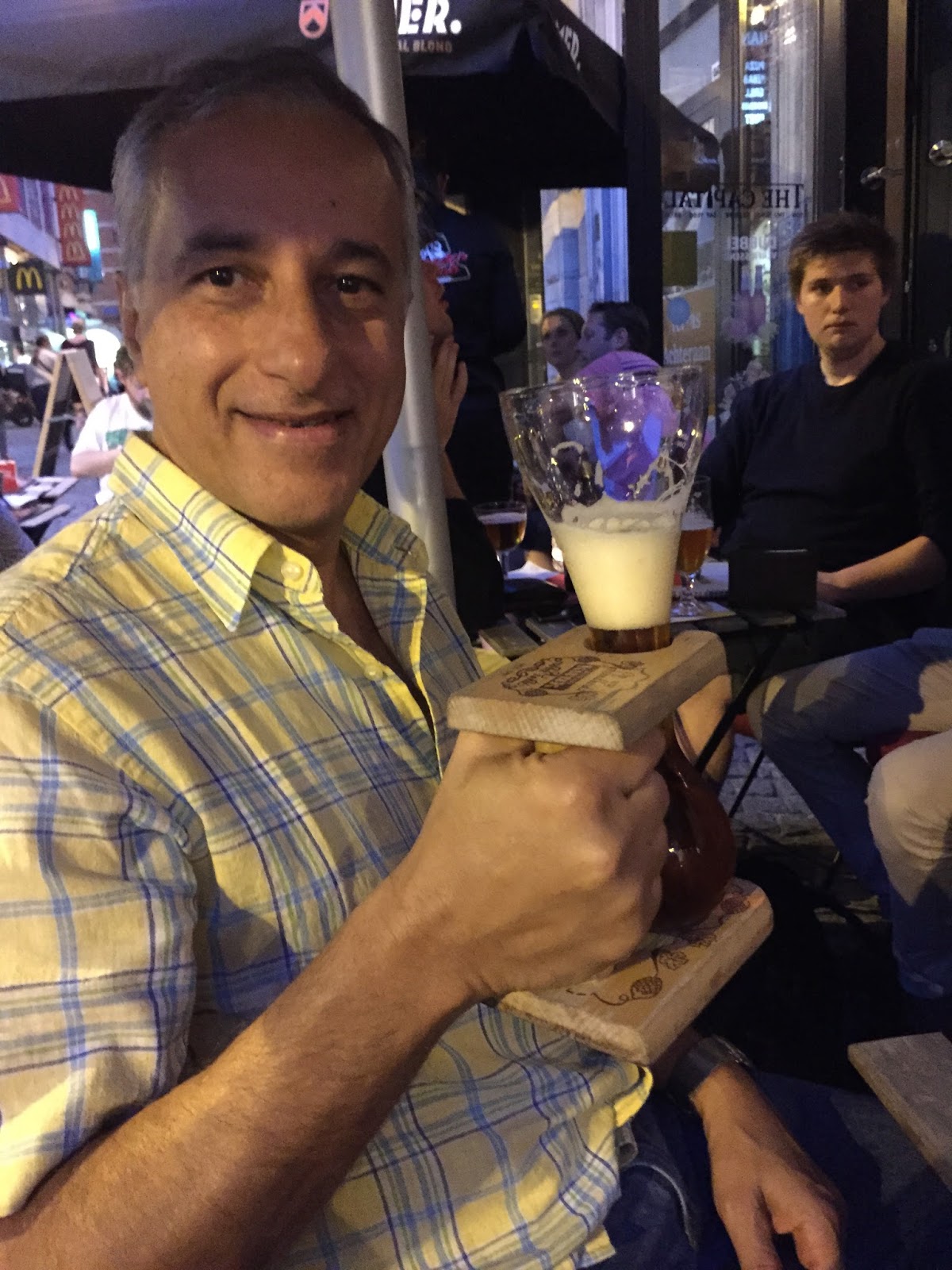
Or we strolled along the plazas full of summer-happy people toasting the long summer light, sampling beer here and there. It was intoxicating in every way! "Capitol Bar" offers 2,000 beers, all of them Belgian. They have an automated wheel that delivers the numbered requests below and then hoists the beers above. Each brand has its own labeled glass or mug...imagine the organization. Here is the floor "window" to the basement:


Then there was the tour-guiding. Leuven is in the northern Flemish region of Belgium, around 100,000 population. I saw structures from the early 1200's, pristine 17th century guild halls and government buildings, then the numerous buildings designated "1914" that had been burned by the Germans and rebuilt after WWI. Plenty of bombings, battles and burnings have occurred over the centuries as warring neighbors traipsed over Belgium. There are many modern structures, of course, blended among the old and the older.

The Dijle River enters, forks into five branches, then unites to exit the city. This provides canal-like waterways that not only enabled commerce historically, but provide beauty and ambiance.

This is the library that was rebuilt after WWII by the USA; we were nicer then:


Leuven's university is the largest in Belgium and is scattered all over the city among buildings from all periods. Students are ubiquitous. Here is the statue honoring this tradition: a book and a beer.


Leuven really functions in such an intelligent way:
-To reduce the noise, pollution, and annoyance of cars, most of the city center has been closed to them. Local residents have remote controls to lower the cylindrical barriers in order to arrive at their homes. The peace and fresh air are a heavenly result.

-Their recycling system for garbage has replaced the garbage collection fee with the requirement of citizens to purchase color-coded garbage bags for the separation of materials. Generate less waste; use fewer bags.

-There is no litter on the streets; how good for my morale, after Natal, along with the generally immaculate maintenance of public spaces and parks.

-Citizens can deduct the cost of having their houses cleaned from their taxes. This encourages employment for low-skilled labor and immigrants.

Mieke's grandparents, parents, she and Joris, and their two daughters all got married at the grand, late 17th century Town Hall:


Here is Mieke having a delicious Rodenbach beer at a bar featuring this adorable, pint-wielding cherub in the murals:


We wandered through this famous beguinage "...a semi-monastic setting where single women could reside for spiritual and material sustenance without retiring from the world." This Unesco World Heritage site dates from the early 13th century; the institution of beguinage ended in 1795. The university now owns the site for married student housing. It is very peaceful; the only sounds we heard were birds singing! Meike's great-grandparents lived here at a previous stage of its history. The site is bordered by two forks of the river.


This utter tranquility continued at Leuven's beautiful Botanical Garden, established by the university in 1738. Again, the only audial accompaniment to the rarified flora was the sound of birds.


Leuven is a beautiful and vital new favorite of mine.

I got to play Granny - my biggest fantasy - when we visited Mieke and Joris' two-month-old grandson, Landers. Their older daughter, Lisbet, lives in a suburb of Leuven.


The three of us headed for Brussels by 22-minute train. Mieke and Joris used to work in Brussels until their retirements; Mieke as a labor mediator, and Joris as the comptroller for the largest television and radio broadcaster. We passed Mieke's former office and had a 'non-tourist' lunch nearby at a favorite, typical Brussels restaurant, Spinnekopke. We had huge mussels from the North Sea, rabbit and steak tartare, along with Belgium's famous fries and beer from the restaurant's own "brasserie," or brewery.

Brussels has a town hall and guild halls from around the same late seventeenth century era as Leuven; in fact, the two cities competed over the grandness of their structures.


An impressive building in Brussels is the massive Palace of Justice. This was constructed in the 19th century on a scale to proclaim the equal importance of justice to religion and to impress upon the citizenry to behave themselves. I can attest, a cathedral could be installed within these dwarfing walls of marble. The Palace has been under renovation for years, with years to go, but we peeked into a courtroom...justice continues to function. This photo is merely a slice of the enormity.

We saw an exhibit of Belgian fashion through the years at the Palais des Beaux-Arts, called simply "BOZAR." Unusual textiles and fantastical avant-garde creations stole the show.

The Manneken Pis, or as I called him, "The Little Pisser," has been pissing into this fountain since at least the fifteenth century! His costume is frequently changed or omitted and his origins remain somewhat mysterious, but he is eternally popular.


Because the city center was traditionally where laborers and immigrants lived, worked and interbred (the wealthy having settled on the surrounding hills), the moniker for citizens of Brussels became "Zinneke," something like "mutt." Here is another pissing statue, honoring the citizens of Brussels! What would one expect with all these breweries since the middle ages?

Mieke is an accomplished seamstress, and we share a love of fabrics and handiwork. There was much to admire in this Belgian lace shop window:

I left my phone/camera behind and depended on Joris for photos of Brussels; as you can see, he included Meike and me in most!


Joris drove us to the South of Belgium to the Ardennes. A dense forest separates the two regions, where the Flemish language (Dutch) is replaced by French, and rolling hills of farmland produce sugar beets, corn, wheat and legumes. We had lunch by the Meuse River and observed the holiday kayakers struggling amidst the rocks. 


Here is the delicate, slightly peach-colored rosé that accompanied our chevre and croquettes:


On Friday morning we met Newton's flight from Shanghai at the Brussels airport. From there we spirited Newton off to Bruges per his earlier request. Actually, Newton survives jet-lag expertly; he managed lunch, a boat tour and a walk around Bruges:


Swans are all over the place!


This dog observing boat tours from the window is a famous fixture of Bruges!


Newton also managed an evening of plaza-and-pub-hopping back in Leuven before expiring for a long sleep. 


On Saturday we took the solar-powered little train/bus tour of Leuven with Mieke's best friend, Chris, whom I already met last year when she visited Natal.


We then sampled the Domus brewery offerings: 


Joris and Mieke drove us ONE MORE TIME to the Brussels airport to catch our flight to Copenhagen for our very first home exchange.

Thank you, Mieke and Joris, for your friendship and for sharing your home, your city, your country, your talent, your great company and your generosity with us! 

Love,
Sandy
Click on left arrows below for Archive Dispatch titles.

Blog Archive